

how brand personality creates differentiation in your online presence
why everything looks the same and what to do about it

have you noticed how everything is starting to look the same?
last week i scrolled through three different pilates studios on instagram and honestly? i couldn’t tell you which was which if you covered their logos. same beige. same neutrals. same minimal aesthetic.
here’s what happens: you want your project to stand out, but there’s this pressure to look ‘professional’ and somewhere along the way, professional started meaning the same minimal, neutral aesthetic everyone else is using. templates make it easy. trends make it tempting. but the cost? your audience can’t find you in the crowd. they can’t remember what makes you different. and honestly, neither can you after a while.
and right now this matters more than ever, with AI making it easier to generate content, designs, and copy in seconds, we’re about to see even more of the same. more templates. more trends. more sameness.
which means the projects that will stand out are the ones that lean into what AI can’t replicate: your specific point of view. your personality. the weird, specific, human details that make your project yours.
having an online presence isn’t optional anymore. your website, your instagram, your emails are probably where most people meet you first. which means these touchpoints are doing a lot of heavy lifting for your business.
so you’re caught in this internal fight, on one side, you know your website needs to perform well. it needs to be user-friendly, intuitive, guide people exactly where they need to go. (i’m all about that ux and user-centered design is literally what i do)
but on the other side you want it to reflect you. your vision. the concept behind what you’re building. you want someone to land on your site and immediately feel the vibe of your project, not just see another template that could belong to anyone.
and i think that’s one of the biggest misconceptions out there: that a website that looks good and reflects your personality somehow can’t also serve your users well. that you have to choose between beautiful and functional.
you don’t.
your online touchpoints: your website, your social media, your emails, whatever you’re using… can absolutely perform well and reflect who you are. but to do that, you need to start with something most people skip: defining your project’s personality.

what differentiation actually looks like
let me show you what i mean with an example.
imagine you’re opening a pilates studio. you know exactly what vibe you’re going for: it’s bold, fierce, unapologetic. you don’t want to be another soft, minimalist studio that blends into the instagram wellness aesthetic. you want people to walk in and feel energized, empowered, maybe even a little intimidated in the best way.
so if your studio was a person, how would she show up?
she’d be direct, she wouldn’t soften her opinions to make people comfortable, she’d be empowering like that friend who pushes you to try that thing you’re scared of, fierce, confident, the kind of person who doesn’t shrink under anyone’s judgment.
her voice would match that energy. not “join us for a relaxing flow” but “show up ready to work.”
you’ve got this clear vision in your head. you can feel it.
but then you go to build the website and here’s where things fall apart.
you look at references and everything is beige and minimal, you second-guess yourself—maybe bold is too much? maybe fierce doesn’t feel “wellness-y” enough? you find a template that’s clean and neutral because it feels safe.
and suddenly, your website doesn’t match that vision you had in your head.
someone lands on your site and they don’t feel that fierce, empowering energy you imagined, they see another pretty, calm, neutral wellness space. the gap between who you wanted to be and what you’re showing the world? that’s where you lose them.
this is what i see all the time: there’s a disconnect between the personality founders envision for their projects and what actually shows up in their online presence.
and it’s not just about aesthetics—though i love talking about design. it’s about the entire experience: your voice, your visuals, your story, the way people move through your site. all of it should echo that same personality.
when there’s alignment, people feel it. they can’t always name why, but they remember you. they choose you over the five other similar options because something about you just clicked.
when there’s misalignment, people feel that too. they get confused. the energy doesn’t match. and they move on.
let me show you what this looks like visually.
here are two moodboards for pilates studios: same industry, same service, completely different personalities.
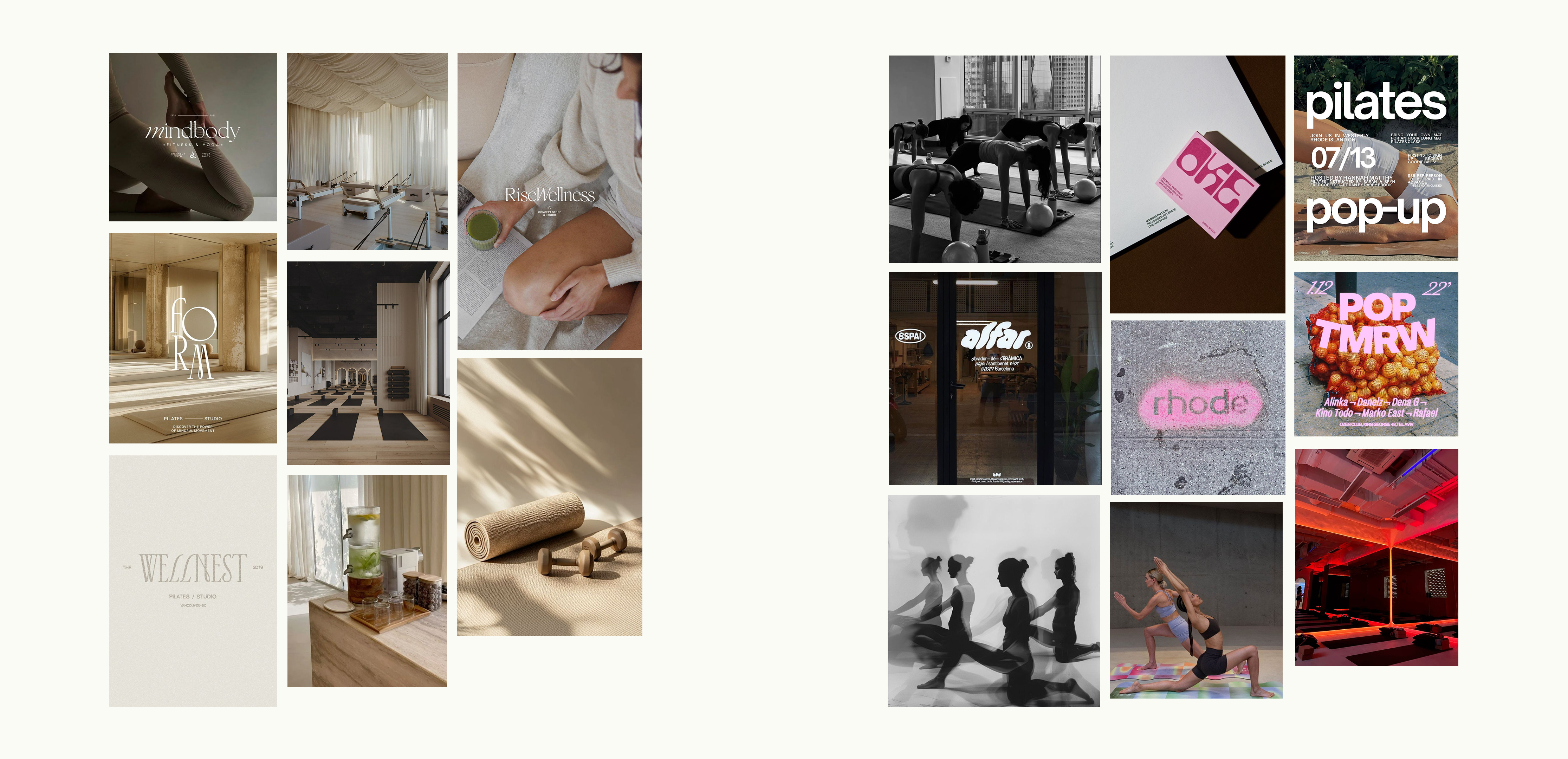
the first one is minimal, neutral tones, clean lines. it’s beautiful, honestly. but you could find three other studios in the same neighborhood that look exactly like this, there’s nothing wrong with it, but there’s also nothing that makes it theirs.
the second one is bold. it has a clear point of view: the colors, the energy, the attitude—you can immediately feel the difference. this isn’t trying to appeal to everyone, it’s saying “if you vibe with this, you’re going to love it here.”
see the difference? it’s not just that one has more color, it’s that one has a clear, defined personality and the other could be... anyone.
and look, i’m not here to hate on minimalism or neutral aesthetics. some of my favorite projects are minimal and intentional. the problem isn’t the aesthetic itself—it’s when you choose it because it feels safe, or because it’s trending, or because you think that’s what “professional” is supposed to look like.
if minimal and neutral is true to your vision? if it genuinely reflects the energy of what you’re building? perfect, own it completely.
but if you’re choosing it because you’re scared to be bold, or because everyone else in your industry looks that way, or because you think it’s what you’re “supposed” to do—that’s where the disconnect happens.
differentiation isn’t about adding color and calling it a day. it’s not a formula or a checklist. you can’t just make things bright and expect to stand out.
what makes something differentiate is whether it connects with your specific audience. whether it makes them feel seen, valued, understood. whether it reflects your actual vision, not someone else’s idea of what “standing out” looks like.
the neutral studio might be perfect for someone building a calm, meditative practice. the bold studio works for someone building something fierce and empowering.
the question isn’t “which one is better?”
the question is “which one is true to what you’re building?”
this is where personality becomes your north star.
when you’re clear on your project’s personality: how it behaves, how it speaks, what it stands for—you’re not making design decisions based on trends or what you think you’re “supposed” to do, you’re making decisions based on alignment.
does this font reflect my project’s voice? does this color palette evoke the feeling i want people to have? does this copy sound like how my project would actually talk?
Donald Norman said it perfectly in Emotional Design: “everything has a personality: everything sends an emotional signal... even where this was not the intention of the designer, the people who view the website infer personalities and experience emotions.”
whether you design your personality intentionally or not, people are going to feel something.
the question is: are they feeling what you want them to feel?
and here’s something that backs this up: a Nielsen report found that 59% of consumers prefer to buy from brands that align with their values.
when your brand’s personality mirrors your audience’s values or lifestyle, they don’t just buy from you once. they come back. they recommend you. they choose you over cheaper or more convenient options because they feel connected to what you’re building.
but that only works if your personality is clear and consistent across every touchpoint.
how to build personality into your project
so how do you actually build personality into your project?
it starts with thinking about your project as if it were a person. i know that sounds abstract, but stay with me, this is where everything clicks.
if your project walked into a room, how would it introduce itself? what would it wear? how would it talk? would it be the person cracking jokes or the one asking deep questions? would it show up in a blazer or vintage jeans?
these aren’t silly questions. they’re the foundation of every decision you’ll make about your online presence.
because once you can answer “how does my project behave?”—you suddenly have a filter for everything.
your personality needs to show up consistently across three main layers:
your voice and tone – how you communicate
this is how your project sounds. is it warm and conversational, or sharp and direct? does it use humor, or is it more straightforward?
your voice shows up everywhere: your website copy, your instagram captions, your email newsletters, even your error messages. and when your voice is consistent, people start to recognize you before they even see your logo.
your visuals – how it looks
this is where design comes in, and it’s what i love talking about. fonts have personality. colors evoke specific feelings. the way you use space on a page says something about who you are.
when you’re designing with intention, you’re not picking fonts because they’re trendy or colors because you like them. you’re asking: does this reflect my project’s personality? does this create the feeling i want people to have?
your story – the journey that shapes you
this is the context. why did you start this? what do you care about? what’s the vision driving everything you do?
your story isn’t just an “about page” thing. it’s woven into how you talk about your work, the values that guide your decisions, the way you show up even when no one’s watching.
the thing is:
you can’t just nail one of these and call it done.
you can have beautiful visuals, but if your copy sounds generic, the personality falls flat.
you can have a compelling story, but if your design doesn’t match that energy, people won’t believe it.
you can have a distinct voice, but if your visuals feel like a template, the personality gets lost.
all three layers need to work together. that’s when people feel the full experience of who you are, and that’s when they remember you.
my hot take here: the most important person in this entire process is the founder. your ideas, your vision, your specific point of view—that’s what makes your project different, and that means you have to protect those ideas.
if you’re constantly consuming what everyone else in your industry is doing, your ideas will start to blend with theirs, you’ll lose the edge that makes your perspective unique.
so create more than you consume. trust your vision. go all in on what feels true to you, even when it feels scary or different.
because that’s where the magic is. that’s where personality lives.
what to take away
what i want you to take away from this:
differentiation isn’t a formula, it’s not about following steps or checking boxes. it’s not about being the loudest or the boldest or the most colorful.
it’s about being the most you.
in a world where customers have endless options, where everything is starting to look the same, where AI is making it easier than ever to generate more sameness, the projects that will stand out are the ones that lean into their specific personality.
the ones that know who they are, what they stand for, and aren’t afraid to show it.
your online presence: your website, your instagram, your emails, every single touchpoint should feel like an extension of your vision, not a compromise, not a template, not what you think you’re “supposed” to do.
building something with a clear, authentic personality takes thought, it takes intention, it takes trusting yourself enough to make choices that feel true, even when they feel different from what everyone else is doing.
but it’s worth it.
because when your personality is clear and consistent across everything you do, your audience doesn’t just see you—they feel you, they recognize you. they remember you. and they choose you, not because you’re perfect, but because you’re real.
so if you’re building something that matters to you, it being a brand, a business or a project you deeply care about, start by getting clear on its personality.
ask yourself: if this was a person, how would it show up in the world?
and then, bring that to life in everything you create.
if this resonated with you, or if you’re working through these questions for your own project and want to talk through it, i’d love to hear from you. you can find me on instagram @designminerva or reach out directly at mine.gonzalezalcala@gmail.com